
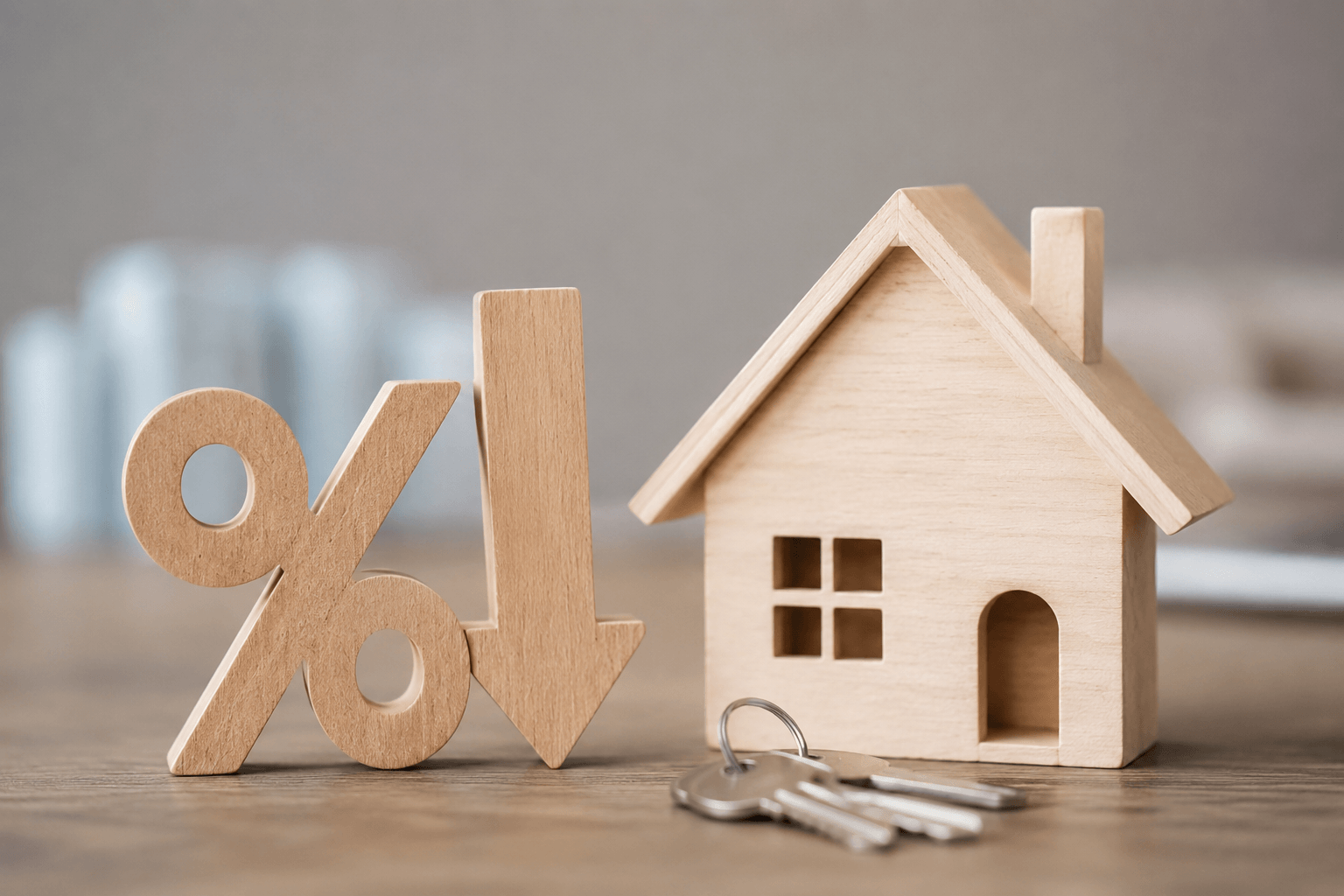
Interest in investing seems to be growing again these days. People are talking about a wide range of assets, including stocks, bonds, and gold. Yet among them, real estate remains the asset that attracts the most attention. That’s because housing is closely tied to everyday life, and it’s also one of the markets most affected by changes in interest rates.
Whenever the possibility of an interest rate cut is mentioned, many people immediately ask, “Does this mean home prices are about to rise?” The logic seems simple: lower interest rates reduce borrowing costs, making mortgages more affordable and increasing demand for homes.
In reality, however, the housing market doesn’t work that simply. Interest rates are certainly an important factor, but they are only one piece of the puzzle. A rate cut alone doesn’t immediately determine where home prices will go.
1️⃣ Rates Move First, Housing Reacts Later
When central banks cut interest rates, many people assume that home prices will soon start rising. The reasoning is straightforward: lower interest rates reduce borrowing costs, making it cheaper to finance a home purchase.
In reality, however, the housing market responds much more slowly.
The Gap Between Policy Rates and Mortgage Rates:
A central bank’s policy rate does not immediately translate into lower mortgage rates at commercial banks. Lenders also take several other factors into account, including:
- Their own funding costs
- Credit and risk premiums
- Overall market interest rate conditions
As a result, even when headlines announce an interest rate cut, the mortgage rates available to homebuyers often decline more gradually.
Financial Markets React Instantly. Housing Does Not.
Financial markets respond to interest rate announcements almost immediately. Stock and bond prices can move within minutes—or even seconds—after a rate decision is released. Algorithmic trading systems and institutional investors adjust their positions quickly, allowing new expectations to be reflected in asset prices almost instantly.
The housing market works very differently.
Homebuyers need time to reassess their finances, income, and future expectations. Sellers often wait to see whether prices will improve before adjusting their asking price. At the same time, mortgage applications, credit approvals, and legal paperwork all take time.
Unlike stocks and bonds, which can be bought and sold almost instantly, a real estate transaction typically involves price negotiations, mortgage approval, and settlement before ownership is transferred. That process usually takes weeks—and in many cases, even months.
👉 You may also like: Why Asset Allocation Matters — A Core Principle of Long-Term Investing
2️⃣ Transactions Move Before Prices
When expectations of an interest rate cut begin to build, the first thing that usually changes is market activity—not home prices. Lower borrowing costs encourage more people to consider buying a home, which often leads to several early signs of increased demand, including:
- More mortgage inquiries
- More property searches and home viewings
- Previously hesitant buyers returning to the market
However, home prices usually do not rise immediately. That’s because prices are not determined by demand alone. A property price is established only when both buyers and sellers agree on the same value and complete a transaction.
Another reason is price rigidity among sellers. Real estate is a long-term asset that changes hands relatively infrequently. Because of this, sellers are often reluctant to lower their asking prices, while buyers may hesitate to act immediately, wondering whether lower interest rates will last or prove to be only temporary.
During this period, transaction volume tends to increase or decrease before prices begin to move, providing an early signal of the market’s direction. Historical housing market data repeatedly shows that during the early stages of a recovery, transaction volume typically rebounds first, while home prices follow only after a noticeable time lag.
For that reason, after an interest rate change, transaction volume is often a more useful leading indicator than home prices. Understanding this sequence makes it easier to interpret what is really happening in the housing market, rather than focusing only on price movements.
👉 You may also like: Why Rising Interest Rates Make Debt More Expensive
3️⃣ Demand Needs Better Loan Conditions

When people buy a home, the first calculation is not the price of the property—it is the financing. Buyers need to know how much cash they have available and how much they can borrow from a bank before they know what price range they can realistically afford. At this stage, lending conditions are often more important than interest rates alone.
Most home purchases are financed through a combination of personal savings and a mortgage. As a result, the factors that determine whether demand turns into actual purchases include:
- Mortgage lending limits
- Debt Service Ratio (DSR) regulations
- Income verification requirements
- Banks’ risk management policies
The Debt Service Ratio, or DSR, measures the percentage of a person’s annual income that goes toward repaying the principal and interest on all outstanding loans. In simple terms, it limits how much a person can borrow based on their income.
Even if the central bank cuts interest rates, borrowing capacity may not increase significantly if these lending conditions remain unchanged. For example, a 0.25 percentage point rate cut may slightly reduce monthly mortgage payments, but if DSR regulations stay in place, the total amount a buyer can borrow often changes very little.
Banks also adjust their lending standards based on economic conditions and housing market risks. When uncertainty is high, banks may keep credit standards tight even as interest rates fall. In that case, more people may become interested in buying a home, but relatively few are able to complete a purchase.
This distinction helps explain why housing markets often remain slow even after interest rates are cut.
Of course, lower interest rates still have an effect. They generally lead to more buyer inquiries and mortgage consultations, as lower monthly payments reduce the financial burden and make buying a home seem more attainable.
However, the strength of that effect depends on lending limits and overall economic stability. If lending regulations remain restrictive, greater interest may not translate into actual demand. Only when lower interest rates are combined with easier lending conditions does stronger demand typically begin to emerge.
4️⃣ Housing Freezes Because of Sentiment
Even when interest rates and lending conditions improve, the housing market does not always respond immediately. One of the biggest reasons is psychology. Real estate is not just a financial asset—it is an asset shaped by both expectations and uncertainty. A change in the numbers alone is rarely enough to trigger immediate action.
A Home Purchase Is a Major Financial Decision
Buying a home is one of the largest financial commitments most people will ever make. Buyers don’t focus only on mortgage rates. They also consider factors such as:
- Future home price expectations
- Job security
- The overall economic outlook
Even if interest rates fall, many buyers will postpone their decision if they are still unsure whether the market has truly reached a turning point.
Sellers Are Often Reluctant to Cut Prices
After a housing downturn, many homeowners become reluctant to accept a lower selling price. Instead, they tend to:
- Wait for signs of a market recovery
- Hold their asking price rather than sell at a loss
As a result, fewer transactions take place, making the market appear stagnant even though buyers and sellers are still watching closely.
Confidence Takes Time to Build
The housing market is heavily influenced by what people see happening around them. Buyers pay close attention to:
- Recent sales in nearby neighborhoods
- Government policy announcements
- News coverage of the housing market
Until enough people believe that home prices are likely to rise, many potential buyers remain on the sidelines, even if they are financially capable of purchasing.
In the end, the housing market moves on confidence as much as on numbers. Even when economic conditions improve, the market can remain quiet until buyers and sellers gain enough confidence to act.
💡 Conclusion – Rates Are a Signal, Conditions Drive Prices
Interest rates are undoubtedly one of the most important factors in the housing market. They reduce the cost of borrowing and provide an important signal about the direction of the economy. That is why news of a rate cut often leads people to expect home prices to rise.
However, interest rates alone do not determine where home prices go. Prices move only when multiple factors come together, including lending conditions, borrowing capacity, transaction activity, the broader economy, and the confidence of buyers and sellers. Interest rates may signal the start of a change, but home prices respond only when the necessary conditions are in place.
For that reason, it is more realistic to look beyond interest rates alone. By paying attention to lending conditions, transaction trends, and market sentiment, you can gain a much clearer understanding of where the housing market is actually heading.