
These days, whenever people talk about investing, gold always seems to come up. In the news, too, gold prices often appear whenever the market becomes unstable. Especially when stocks become volatile or the economy feels uncertain, people naturally start thinking about gold.
That raises an important question: why does gold always receive attention during times like this? Is it simply because gold is an old and familiar asset, or does it play a different role from other types of assets? People around me have also been talking about gold more often lately, so I became curious about this as well.
Many people think of gold as an asset that “goes up in price.” But in reality, gold has a more important meaning than that. In this article, I will explain why gold repeatedly appears in investment discussions by focusing on its structure and role in a simple and easy-to-understand way.
1️⃣ What Kind of Asset Is Gold? — Value Preservation, Not Income
When many people think of gold as an investment, the first thing that comes to mind is “price appreciation.” However, the nature of gold is completely different from stocks or bonds. Gold is not an asset that produces something. Instead, it is closer to an asset that protects value that already exists.
If we compare it with other assets first, the structure becomes easier to understand.
- Stocks => Value increases with company growth (dividends + price appreciation)
- Bonds => Provide fixed interest income
- Real estate => Rental income + asset value appreciation
On the other hand, gold has the following characteristics.
- It does not pay interest
- It does not provide dividends
- It does not generate cash flow on its own
From this perspective, gold may look like an “inefficient asset.” Then how has gold been recognized as a valuable asset for thousands of years?
The reason is that gold is specialized in the role of “preserving value.”
Let’s look at this a little more closely.
- An asset that becomes a reference point when currency value becomes unstable
- Gold is not issued by a country or a central bank. In other words, it cannot be printed endlessly like currencies such as the dollar.
- That is why when the value of money falls, the value of gold tends to remain stable or rise relatively.
- An asset that does not lose its value over time
- Companies can fail, and bonds can default.
- But gold itself does not disappear or go bankrupt.
- This is the key point that makes gold a “final safe-haven asset.”
- An asset recognized globally
- Gold does not depend on one specific country or financial system.
- In other words, its exchange value is recognized almost everywhere, and this characteristic becomes even stronger when the financial system becomes unstable.
In short, gold is closer to a tool for protecting the value of assets you already have, rather than an asset for “making money.” At first, I also thought gold was mainly used as an investment for profit. But I have come to understand that gold is actually a safe-haven asset, and that earning high returns from it is relatively difficult.
So the important point in investing is not to expect profit from gold, but to understand how gold can help protect the overall value of your assets.
👉 Related reading: Why Rising Interest Rates Make Debt More Expensive
2️⃣ How Does the Price of Gold Move? — The Relationship Between Interest Rates and Inflation
To understand gold prices, it is much clearer to look at two key factors: interest rates and inflation, rather than only focusing on simple supply and demand. Since gold does not pay interest, its attractiveness is decided by how it compares with interest-bearing assets.
- The basic relationship between interest rates and gold prices
- Interest rates and gold generally tend to move in opposite directions.
- When interest rates rise:
- Bank deposits and bond yields increase
- Gold becomes less attractive because it does not pay interest
- Downward pressure on gold prices may increase
- When interest rates fall:
- Interest income decreases
- Gold becomes relatively more attractive
- Gold prices may have room to rise
- How inflation affects gold
- Inflation is another key factor in understanding gold prices.
- When prices rise:
- The value of money falls
- Preference for real assets increases
- At this point, the reason gold is chosen becomes clear.
- As the value of money declines, gold can become more valuable.
- Gold has limited supply
- It is recognized globally as a store of value
- It can help maintain purchasing power over the long term
- That is why when inflation becomes higher, a structure is created where demand for gold tends to increase.
- The real key is “real interest rates”
- The most important variable is the real interest rate.
- Real interest rate = nominal interest rate – inflation
- To explain it more simply:
- Nominal interest rate => the interest rate you see on the surface
- Real interest rate => the “actual return” after considering inflation
- So when real interest rates rise:
- Actual interest returns increase
- Gold becomes less attractive
- On the other hand, when real interest rates fall:
- The value of money decreases more quickly
- Demand for gold increases
- The actual market flow can be summarized in one simple way:
- Interest rates ↑ + low inflation → gold tends to be weak
- Interest rates ↓ + high inflation → gold tends to be strong
- Real interest rates ↓ → gold is more likely to rise
Because of this, gold prices are determined within the balance between interest rates and inflation.
3️⃣ When Does Gold Become Stronger? — Asset Flows During a Crisis
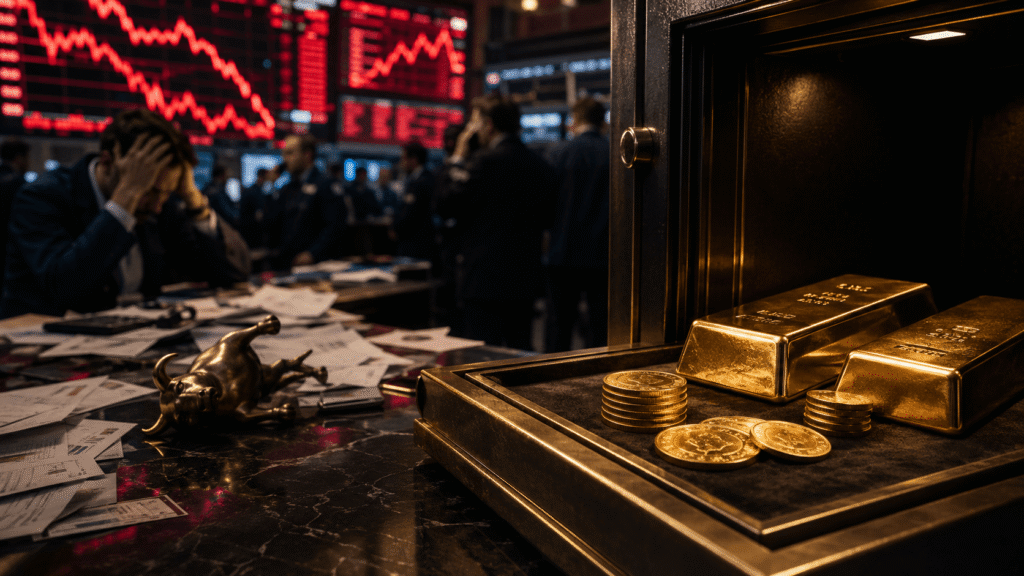
Gold does not usually receive much attention during normal times, but once uncertainty appears in the market, its presence becomes much more noticeable. This is not simply because demand increases. It is because the direction of money flow itself changes during a crisis. In stable periods, investors tend to pursue returns. But when uncertainty grows, the standard of judgment changes clearly.
During this period, the more important question is not “How much can I earn?” but “How much can I protect?”
- How money flows change during a crisis
- When the economy is stable, money naturally moves toward growth assets.
- Stocks, technology stocks, and high-risk assets
- Investments that are expected to generate higher returns
- But when a crisis begins, the flow changes step by step.
- Step 1: Money moves away from risky assets
- Step 2: Money moves into safer assets such as bonds
- Step 3: If the crisis becomes more serious, money moves into gold
- In other words, gold is a defensive asset that is often chosen in the final stage.
- When the economy is stable, money naturally moves toward growth assets.
- Why gold is chosen
- The reason gold is chosen during a crisis becomes clear when we look at its structure.
- It does not depend on the credit of a government or company
- It does not carry bankruptcy risk
- It is recognized as valuable around the world
- That is why the more unstable the financial system becomes, the stronger gold’s relative stability becomes.
- The reason gold is chosen during a crisis becomes clear when we look at its structure.
- Common situations when gold becomes stronger
- 1. Financial crises
- Instability in banks and the financial system
- Collapse of trust => money moves into gold
- 2. War and geopolitical risks
- Greater uncertainty about the future => stronger preference for safe-haven assets
- 3. Economic recession
- Slower corporate growth
- Lower attractiveness of stocks => money moves into defensive assets
- 4. Inflation + falling real interest rates
- Decline in the value of cash => stronger preference for real assets
- What all of these situations have in common is that uncertainty about the future becomes much greater.
- 1. Financial crises
Gold is not always an asset that creates returns, but there is a clear reason why it repeatedly appears whenever markets become unstable. Gold acts as the final line of defense that protects the overall value of assets from behind.
I was also curious about why gold prices rise when the global economy feels risky, like they do now. Through this structure, it becomes much easier to understand when we should pay attention to gold and why it is often included in an investment portfolio.
4️⃣ What Role Does Gold Play in a Portfolio?
When viewed on its own, gold may not seem very attractive because it does not generate income. It does not pay interest, and it does not grow like a company. Still, there is a clear reason why many investors include gold in their portfolios. Gold plays an important role in balancing overall assets and managing risk.
- Portfolio stabilization
- The most important role of gold is to reduce the volatility of a portfolio. When the stock market is rising, gold may not stand out very much. But when the market starts to become unstable, its role becomes much clearer.
- When stocks fall, gold often shows a relatively stable movement or even rises.
- This kind of movement can help reduce the sharp decline of the overall portfolio.
- As a result, gold helps lower the instability of a portfolio.
- The most important role of gold is to reduce the volatility of a portfolio. When the stock market is rising, gold may not stand out very much. But when the market starts to become unstable, its role becomes much clearer.
- Diversification effect
- The basic idea of investing is to hold assets with different characteristics together. If all assets move in the same direction, diversification loses its meaning.
- Stocks move based on economic growth
- Bonds are affected by interest rates and stability
- Gold reacts to market uncertainty and changes in trust
- When assets that move according to different factors are held together, losses from one asset can be partly offset by another asset.
- Within this structure, gold acts as an important pillar that helps maintain balance in a portfolio.
- The basic idea of investing is to hold assets with different characteristics together. If all assets move in the same direction, diversification loses its meaning.
- Psychological stability for investors
- Gold affects not only visible returns but also investor psychology.
- This is because when markets fall sharply, all assets may seem to be falling at the same time. As anxiety grows, investors are more likely to make the mistake of selling at the wrong time.
- However, when gold is included as part of the portfolio, the overall decline may be softened.
- This can help investors stay calmer and maintain a long-term strategy.
- In this way, gold also works as a tool that helps investors continue investing without being shaken too easily.
Gold is not an asset that creates income. Instead, it is an asset that supports the portfolio.
- Stocks are for growth
- Bonds are for stability
- Gold is for defense
When these three elements are balanced, a more stable long-term investment structure can be created. Once we understand the role of gold, we can also understand which factors should be considered within an overall investment strategy.
👉 Related reading: How to Choose Stocks: Essential Stock Types and Selection Criteria
💡Conclusion — Gold Is Not an Asset for Making Money
Gold is not an asset that creates quick returns. It does not pay dividends or interest, so from a short-term perspective, it may look inefficient. However, investing is not always only about returns. Markets can become unstable at any time, and in the long run, the ability to protect assets during those periods can strongly affect the final result.
That is exactly the role gold plays. Rather than maximizing returns, gold helps reduce losses and keep the overall portfolio more stable. In that sense, gold is not the asset that leads the portfolio from the front. It is closer to an asset that supports the whole structure from behind.
In the end, investing is not only about how much you make. Sometimes, what matters more is how much you avoid losing.
And from that perspective, gold is an asset that has real meaning.