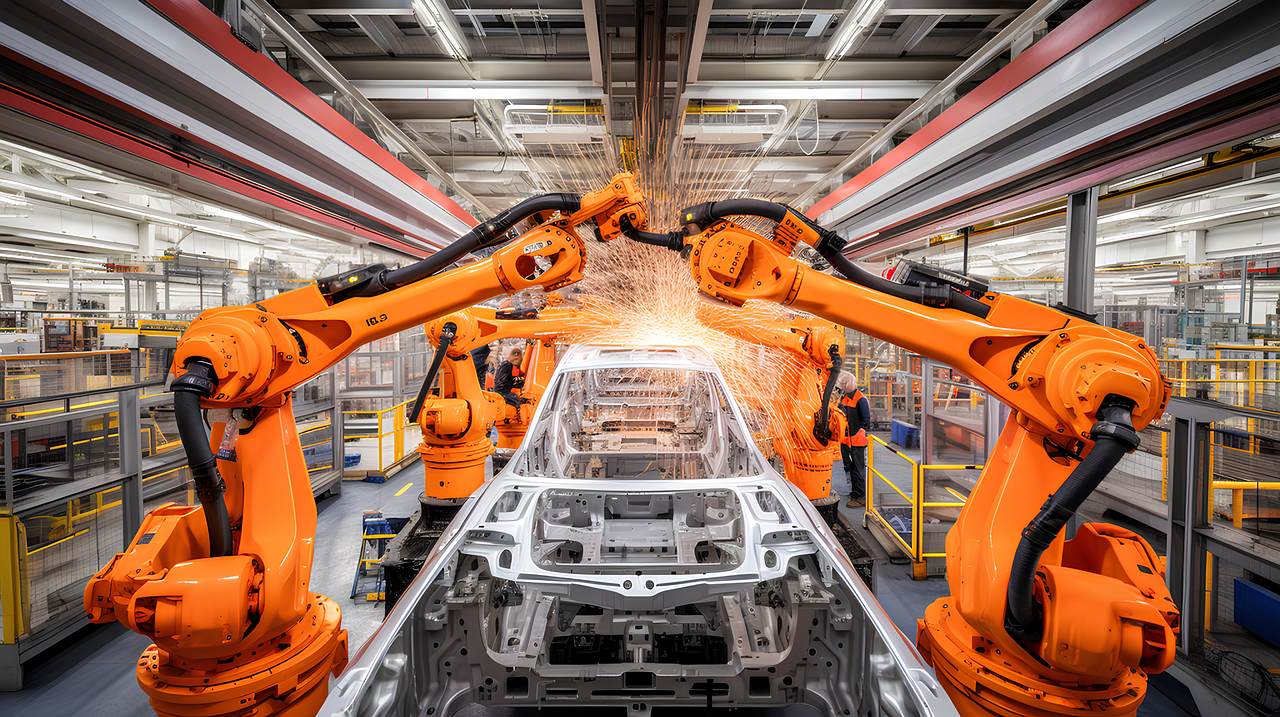
When you follow the news these days, it often feels like AI is constantly being discussed as a job killer. As AI-related stories pile up—factory automation, robot adoption, and AI-driven decision-making—it can start to seem as if production work will be one of the first occupations to disappear. Many headlines group AI and automation together and talk about the idea of “factories that no longer need people.”
However, what is actually happening on the ground looks somewhat different. Production jobs are not vanishing overnight. Instead, the more important change is that the roles people play in production and operations are being restructured.
Today, we will take a closer look at which parts of production work AI is already taking over, and where human involvement remains essential.
1️⃣ How Is Production Work Structured? – Execution, Judgement, and Responsibility
To understand how AI affects production jobs, we first need to understand what production work actually consists of. Work in production and operations may look simple from the outside, but it actually involves a mix of roles with very different characteristics.
Followings are the 3 distinct layers of production work:
- Execution
- Execution refers to tasks that follow predefined instructions and are repeated consistently.
- Repetitive, rule-based activities
- Examples include assembly, processing, and material movement
- Speed and accuracy are the primary performance criteria
- Execution refers to tasks that follow predefined instructions and are repeated consistently.
- Detection & Judgement
- This layer involves monitoring the production process and identifying whether something is wrong.
- Observing process conditions and detecting abnormalities
- Checking for defects, recognizing warning signals, and analyzing patterns
- This layer involves monitoring the production process and identifying whether something is wrong.
- Adjustment & Responsibility
- This is the stage where decisions are made in exceptional situations.
- Setting standards and making decisions when exceptions occur
- Deciding whether to stop production, make adjustments, or change criteria
- Taking responsibility for the outcomes of those decisions
- This is the stage where decisions are made in exceptional situations.
When production work is viewed through the lens of execution, judgment, and responsibility, the impact of technology becomes much clearer.
Automation mainly replaces parts of execution. AI is beginning to influence judgment, but adjustment and responsibility largely remain in human hands.
2️⃣ Production Tasks Replaced by Automation and Robots
In production and operations, the earliest and most visible changes have appeared in the execution layer. Automation systems and industrial robots have been used on factory floors for decades, but recent advances in technology (combined with falling costs), have significantly expanded their scope of adoption.
The tasks most commonly replaced by automation and robots share clear characteristics, which are fixed rules and high repetition.
Examples include:
- Assembly and processing tasks that repeat the same movements
- Logistics support tasks such as transporting and loading materials in a predefined sequence
- Simple process controls that operate based on fixed thresholds
- Tasks where speed and accuracy matter more than human skill or experience
These tasks all have one thing in common, what needs to be done is already clearly defined. Conditions are stable, exceptions are rare, and human judgment plays a limited role. Automation and robots are therefore well suited to executing predetermined tasks quickly and consistently.
An important point to recognize is that this shift is not driven by AI alone. Automation at the execution level is fundamentally about replacing physical movement, not judgment. These tasks can be automated even without AI. That is why the first production tasks to disappear are not those that require decision-making, but those that are closest to repetitive execution.
3️⃣ Judgment Tasks AI Has Begun to Take Over in Production
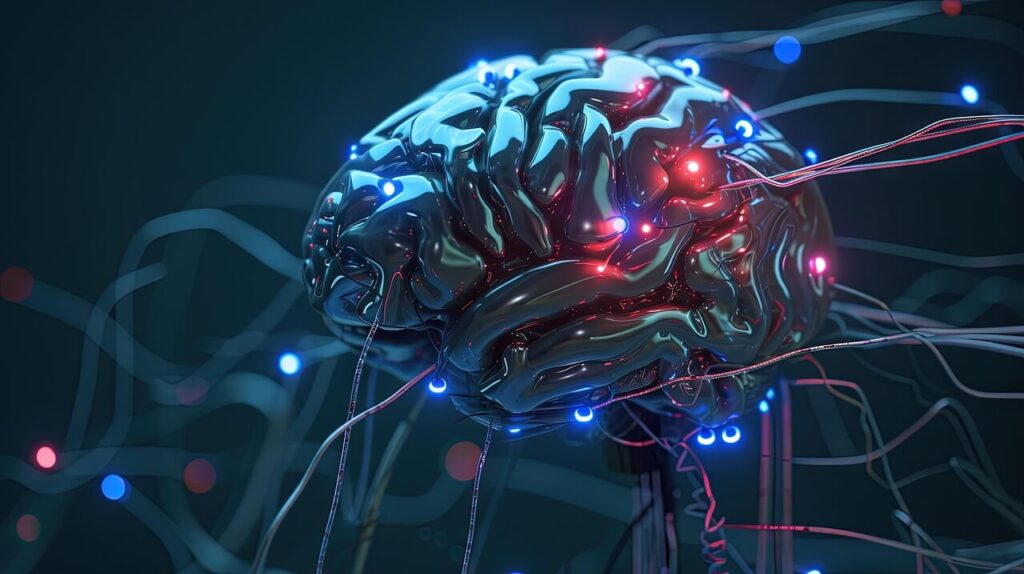
If automation and robots replaced much of the execution layer, the real impact of AI emerges in the next stage; detection and judgment.
This shift is no longer a theoretical possibility. In many manufacturing environments, AI is already being used in practice, especially in situations where it is difficult for humans to monitor large volumes of data simultaneously. In such settings, AI often plays a decision-support role, rather than acting as the decision-maker itself.
Common judgement-related tasks where AI used on the manufacturing include:
- Quality inspection using cameras and machine vision
- Detecting micro-defects or abnormal patterns that are easy to miss with the human process
- Process anomaly detection based on sensor data
- Identifying unusual patterns in temperature, vibration, or pressure
- Predictive maintenance decisions based on equipment data
- Flagging potential failures before breakdowns occur
- Production condition recommendations reflecting process and demand changes
- Suggesting adjustments to operating parameters based on shifting conditions
In these areas, AI does not directly control the production process. Instead, it delivers signals, such as “the likelihood of a problem is rising” or “this pattern deviates from normal”, faster than humans can.
What AI replaces here is not the final decision, but the process of preparing judgment. On the manufacturing operations, AI functions as a tool that supports and accelerates human decision-making, rather than replacing human responsibility.
4️⃣ What Roles in Production Cannot Be Replaced by AI?
AI is increasingly capable of interpreting process conditions and supporting judgment on the factory floor. However, the decision of how far to act on that judgment still rests with humans. This is not simply a technical limitation. It is, in many ways, a deliberate boundary. In production and operations, final decisions are inseparable from responsibility, and responsibility ultimately belongs to people.
Key production roles that AI cannot replace include:
- Setting judgement criteria
- Defining what counts as “normal” and determining the thresholds at which an issue becomes a defect
- Decision-making in exceptional situations
- Choosing whether to stop production or make adjustments when AI raises a warning
- Bearing responsibility for decisions
- Taking final accountability for quality issues, delivery delays, or cost increases
- Redesigning the system itself
- Deciding whether to maintain existing processes or fundamentally change their design
In these areas, context matters more than data. The same signal may lead to different decisions depending on customer requirements, delivery constraints, or cost structures. That is why AI-generated judgments remain recommendations, while final decisions stay in human hands.
Ultimately, what AI cannot replace in production is not technology, but judgment that carries responsibility.
💡Conclusion – Will AI Reduce Manufacturing Employment? Role Redesign and Structural Change
It is clear that AI and automation are reducing manufacturing employment. As repetitive execution and simple judgment tasks decline, fewer workers are needed to maintain the same level of output.
However, this shift is more often reflected in slower hiring and role transitions, rather than large-scale layoffs. At the same time, the roles demanded on the production side are changing. Increasingly, workers are expected to understand production processes, interpret AI-driven judgments, and take responsibility for outcomes.
In this sense, manufacturing jobs in the AI era are not disappearing—they are being redefined. What changes is not the existence of the job itself, but its structure and criteria. And this transformation is no longer limited to production and operations; it is spreading into other areas of business as well.
In the next article, we will move beyond production to explore how AI is reshaping decisions about what to make, when to produce, how much to supply, and how goods are distributed.